

Many young couples have dogs or cats long before they have children, and treat them as part of the family. So when a baby is on the way, the first question usually isn't "should we keep the pets?" but "how do we make sure the baby and the four-legged ones can live together safely?"
The good news is that it's entirely possible, as long as you start early enough.
Start preparing during pregnancy
Experts agree that the earlier, the better. As soon as you know a baby is on the way, you can start preparing your pets. "This is a major change to their environment, so the sooner the better," one vet explains. The reason is simple: "Dogs do like routine and consistency."
There are a few things worth doing in the months before the birth. First, brush up on basic commands. "Leave it" is especially useful, because pacifiers, bottles, baby blankets, breastfeeding equipment, baby toys and diapers are not dog toys! Second, get your pet used to new sounds and objects. If you plan to use a baby sling to carry the baby, wear it frequently now. You can put a doll in it to help acquaint the pet with your "new look". It may be helpful to get a CD of baby sounds such as crying and gurgling and play it frequently so that these sounds are not new to the pet when the baby arrives.
Third, change your pet's routine gradually. Life with a new baby can be hectic and sometimes unpredictable, so it may also be helpful to prepare your pet for a less consistent schedule by varying her feeding times.
With cats: mind the litter box
If you have cats, there's one thing to pay particular attention to during pregnancy. Pregnant women should, when possible, have someone else clean their cat's litter box. That's because cats can have an infection called toxoplasmosis. Usually, cats catch it outdoors by eating rodents, birds, or other small animals. Often, it won't cause symptoms in a pregnant woman who gets infected, but she can still pass it to her developing baby.
Prevention is fairly easy. Keep your cat indoors and feed it commercial dry or canned food (not raw food) to help lower its risk of getting infected. If you have to tackle the task yourself, wear disposable gloves and wash your hands after you're done. Clean the litter box daily. (The parasite that causes toxoplasmosis won't become infectious in a cat's feces for one to five days.) It's also worth remembering that most infections come from food, not cats, so there's no need to rush into rehoming your cat.
The first meeting
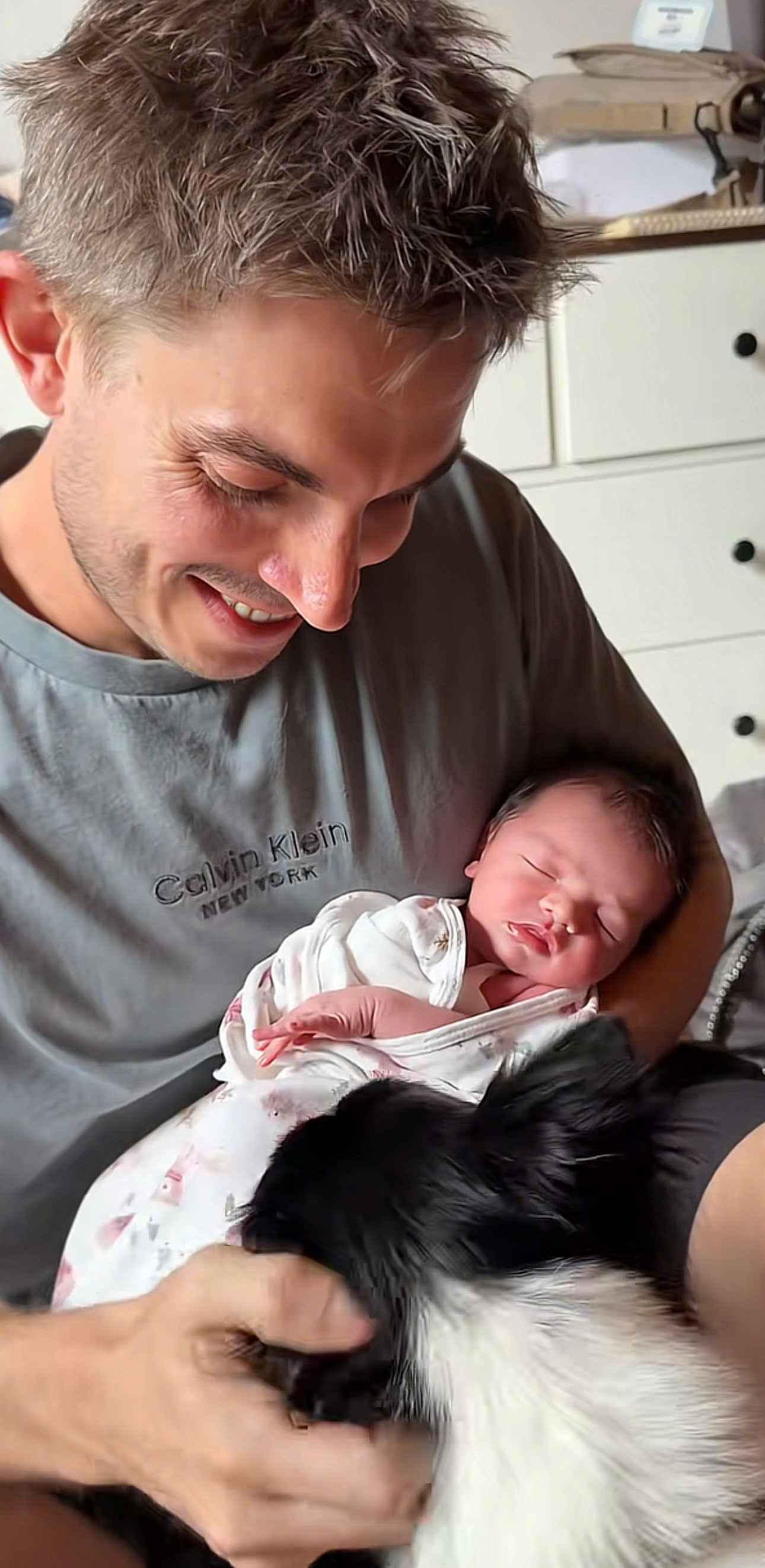
When you bring the baby home, don't rush to put them close to your pet. As one dog trainer puts it: "We never take the baby to the dog. Let him make the choice when he's been invited." With dogs, with active supervision, leash your dog and let them sniff the baby from a safe distance. End on a positive note (treats, praise, playtime) after the brief interaction.
Another small tip is to let mum greet the pet first. According to the AKC's trainers, mom should give the dog a warm welcome to let him or her know she missed them too.
Cats need a different approach. Cats are more independent creatures with their own personality quirks, so they require a different approach than dogs. Usually it's best to let a cat watch from a distance and come closer when it's ready.
The most important rule: never leave the baby alone with a pet
Almost every animal welfare organisation repeats this. Even the most tolerant pets should never be left alone with babies and young children. As tempting as it is to leave the room to answer the phone, or use the restroom, or turn off the oven, etc., the baby should go always go with you or the pet should be in its "safe zone."
The rule applies even when the baby is in a cot or a seat. Never leave your baby alone with your dog, even when the baby is in a crib, bassinet, high chair, playpen, rocker/bouncer, swing, doorway jumper, bathtub, baby carrier, car seat, or stroller. If you have a nanny or helper, don't ask baby sitters to be responsible for both baby and dog. When you leave your baby with a sitter, keep your dog in a secure confinement area.
And it isn't just for the newborn stage. One trainer suggests closely monitoring your dog around your child until they're a young teen.
Create safe zones for both
Pets need somewhere to retreat to when the house gets too noisy or they want some peace. You can use a crate or baby gates to help your dog acclimate to the new baby. Ideally, you'll have crate-trained your dog before you bring the baby home. Gates can also keep pets out of the nursery: experts advise, don't allow unsupervised access to the nursery.
With cats, set boundaries early: don't let your cat sleep on anything that belongs to your baby, including the crib, swing, or bassinet. The sooner you can set these boundaries, the better.
Keep things hygienic
Hygiene is a small thing that matters. Cats can pose health risks to newborn babies and children, but with proper hygiene and care, the chances are minimal. Make sure you wash your hands after petting your cat and changing their litter box. The same goes for dogs. Experts advise to limit or avoid licking. Though a dog affectionately licking a baby may look cute, it can be a germy practice, and babies have delicate immune systems.
Don't forget your pet is adjusting too
Amid the sleepless nights, it's easy to forget that your pet is going through a big change as well. While you'll undoubtedly be preoccupied with your new baby, don't forget your pet is going through a transition, too. Try to keep familiar routines: try to keep to the dog's usual routine, they will still appreciate their walks and one to one time with you. Don't forget their mealtimes. And if you're struggling, it's OK to ask for help and hire a pet sitter to give your pup extra attention while you tend to the baby.
Signs to watch for
Every animal reacts differently. Some are curious, some are scared, some are jealous. Look out for changes like eating less, hiding more, toileting in the wrong places, or growling or baring teeth when the baby cries. If they seem unduly frightened, you might want to seek help from a behaviorist; your veterinarian might be able to refer you to someone. Consult your veterinarian if you notice changes in your pet's behavior.
In the longer term, as the baby grows, teaching them how to treat animals matters just as much. Even if your pets are extremely tolerant, children need to be taught to be gentle with animals. Eventually they will be around someone else's pets who might not be so tolerant.
Case study: Lilthu
In Lilthu's home, pets are full members of the family: she has a dog called Doja and two cats, Louis and Chad. Rainy days spent at home with them are moments she often shares on Instagram. Her love of animals goes beyond her own home too: in 2024 she held a fundraising garage sale with Laws For Paws Vietnam, a group that rescues and rehomes dogs. Now that the family has a new baby, her story is like that of many young families: it isn't about choosing between pets and a child, but finding a way for everyone to live safely under one roof.
Sources: American Kennel Club — Expecting a new human · RSPCA Australia — Will my newborn baby be safe around my dog? · Best Friends Animal Society — How to introduce a baby to a dog · The Ohio State University Wexner Medical Center — How to introduce your baby to your pet · The Ohio State University — Introducing your dog to your new baby · Chewy — Dogs with newborns · PetMD — What not to do with dogs and babies · The Kennel Club (UK) — How can I keep my baby safe around my dog? · City of Austin Animal Services — New baby · UNC Health Talk — How to prepare your pet for a new baby · Care.com — How to introduce a dog to your new baby · KidsHealth — Can I clean our cat's litter box while I'm pregnant? · Purina — Cat litter box & pregnancy · HealthyChildren.org (AAP) — Protecting against toxoplasmosis · Catster — Can cats make babies sick? · Clearblue — How to introduce your newborn to your cat
Hashtags: #PetsAndBaby #DogsAndBabies #CatsAndBabies #NewParents #PetParents #BabyPrep #Pregnancy #PetSafety #Toxoplasmosis #DogTraining #FamilyLife #LawsForPaws #Lilthu